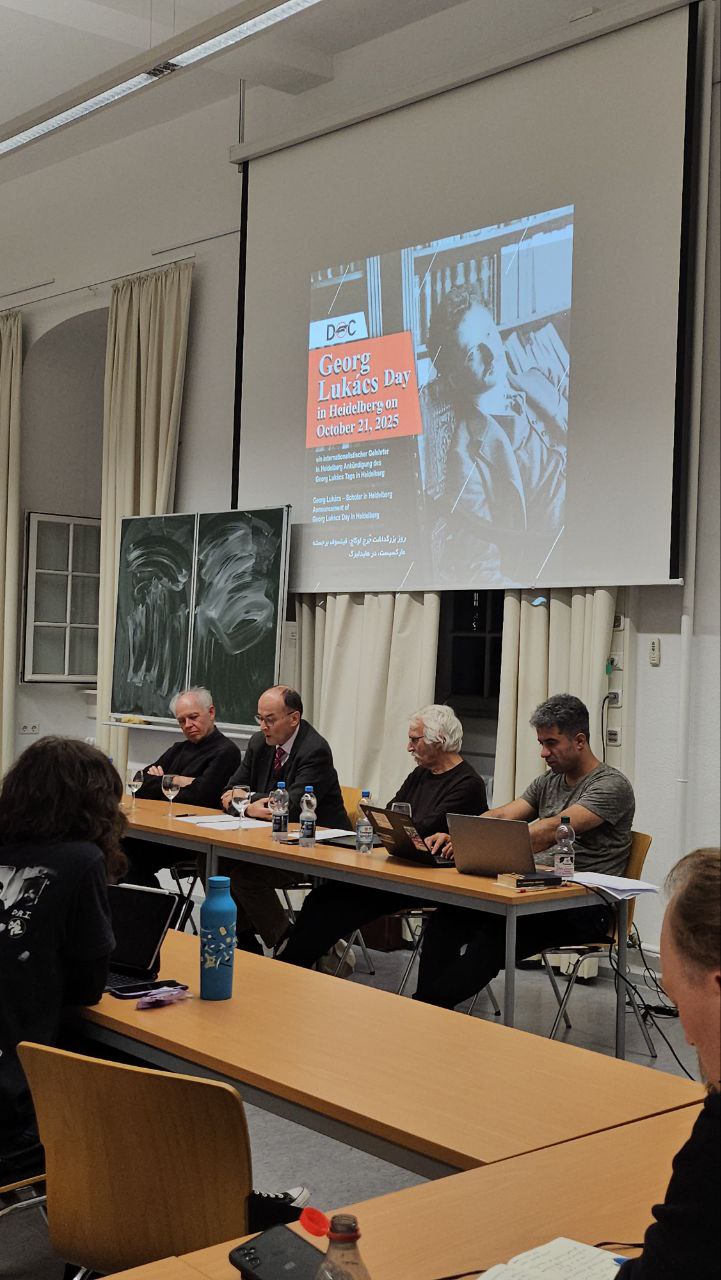
Press release by Hassan Maarfi Poor, Heidelberg University, and Dr. Rüdiger Dannemann, General Secretary of the International Georg Lukács Society
On Tuesday, October 21, 2025, the city of Heidelberg witnessed a historic day dedicated to the memory and life of one of the most significant thinkers in human history and one of the most outstanding intellectuals of the 20th century.
The Georg Lukács Day began with the ceremonial unveiling of a commemorative plaque at his former residence at Keplerstraße 28, where Georg Lukács lived from 1914 to 1918. More than forty interested parties and admirers of Lukács from all over Germany and abroad took part. This ceremony marked the start of a long day that proved fruitful in both academic and cultural terms. Numerous journalists from Heidelberg and regional newspapers attended the event and captured this day as a piece of city history with many photos.
The ceremony was initiated and organised by Hassan Maarfi Poor. After the unveiling of the memorial plaque by Maarfi Poor and Rüdiger Dannemann, chairman of the International Georg Lukács Society in Essen, Dannemann opened the day with a short lecture on Lukács’ intellectual biography, his personal ‘transcendental homelessness’ in his home country, and his role in the development of 20th-century thought, particularly in Heidelberg. He concluded by pointing out the positive turn in the case of the closed Lukács Archive and reading an email from Prof. Axel Honneth, who thanked the city of Heidelberg for its courage in commemorating Georg Lukács’ stay at its own university.
Dr. Thomas Petersen, Lecturer in Philosophy at the University of Heidelberg and supervisor of Maarfi Poor’s dissertation, gave a short lecture on the significance of History and Class Consciousness for the student movement of the 1960s, emphasizing that this work was of central importance for the movement at that time. After the brief speech by Thomas Petersen, Michael Buselmeier spoke. He is one of Heidelberg’s best-known intellectuals, author of numerous books on the city’s history, and an important representative of the city’s cultural life. He gave a short, but partly controversial, lecture on Lukács’ role in Heidelberg. Buselmeier expressed the view that other thinkers who had lived in this house were of greater significance for Heidelberg than Lukács.
Following this, Hassan Maarfi Poor spoke about the significance of this special day and explained the day’s program. Afterwards, a city tour began, during which the houses of important intellectuals such as Alfred Weber and other members of the so-called Heidelberg Circle around Max Weber, who had friendly relations with Lukács, were visited.
From 1:00 PM to 3:30 PM, the participants were invited to lunch, after which the city tour continued. The group visited, among other places, the Deutsche Bank, where Lukács’ early writings were kept in a safe for over fifty years. Afterwards, the participants moved along Heidelberg’s Hauptstraße to the evening event in the Kant Hall of the Faculty of Philosophy, which was completely filled with over seventy visitors from various social and political circles.
Since the writer and poet Sara Ehsan could not take over the moderation due to illness, Maarfi Poor moderated the event himself and shortened his own lecture to keep the duration of the session within the time frame. First, Maarfi Poor gave a general introduction to the “Georg Lukács Day,” the program schedule, and a brief overview of Lukács’ life and work. He emphasized that Lukács was not only one of the most significant thinkers of the past century but also one of the most important thinkers in the entire history of thought – a universal scholar who explored disciplines such as aesthetics, philosophy of art, sociology, theory of history, politics, Marxism, and ontology with extraordinary depth. Maarfi Poor pointed out that a return to Lukács and a “Lukács Renaissance” in a time when the danger of fascism is greater than ever could form the basis for developing anti-capitalist and anti-fascist knowledge – knowledge that, unlike the Frankfurt School, does not accommodate power structures but instead becomes an uprising against bourgeois sciences.
In the evening, as announced, four lectures took place. However, due to illness, numerous originally planned participants could not attend, so ultimately over twenty guests were absent with apologies.
The first lecture was given by Rüdiger Dannemann, who outlined the stages and leitmotifs of a controversial philosophical classic and its relevance today, emphasising the connection between reification and alienation in Lukács’ early and late work. He stressed the central role of these two concepts as characteristic features of the capitalist system, which could not exist without reification and alienation. Dannemann showed that Lukács’ theory of reification was one of the great diagnoses of the 20th century and that he had developed it further in his ontology of social being beyond history and class consciousness into a theory of plural forms of alienation and reification. His philosophical approach is relevant in many respects, above all as an articulation of a critical theory that truly deserves this name and can help to develop a universalistic perspective for the multitude of resistance movements currently active.
Despite the broad reception of his work, there are still many open research questions, e.g.: To what extent can the concept of class consciousness developed in History and Class Consciousness be integrated into current debates on location philosophy, gender and postcolonial studies? Or: What new perspectives arise for new readings of classical German philosophy based on Kant’s and Marx’s understanding of philosophy? In addition, his late work awaits a reception on a par with his earlier and middle periods.
This was followed by Peter König, professor emeritus of philosophy at the University of Heidelberg and a well-known figure in the city. He spoke about Lukács’ early works and emphasized the significance of “Form”—both the essay form and the form of life—in this creative phase. König began with an important letter from Lukács’ The Soul and the Forms (Die Seele und die Formen), which Lukács wrote to his close friend Leo Popper, and continued with another essay about Kierkegaard and his relationship with Regine Olsen. He showed how Lukács, in his youth, placed romantic themes at the center of his aesthetic system.
Following this, Thomas Petersen spoke about Lukács’ conception of Realism in connection with Goethe and Thomas Mann. Using a quote from Roger Scruton’s Fools, Frauds and Firebrands: Thinkers of the New Left, he criticized the opportunist tendencies of the Frankfurt School. Thomas Petersen writes the following, referring to Scruton:
“The conservative British philosopher Roger Scruton published a book about the thinkers of the New Left titled ‘Fools, Frauds and Firebrands’. Polemical like the title are also the chapter headings such as ‘Resentment in Britain’, ‘Nonsense in Paris’ or ‘Culture Wars Worldwide’. Germany is also considered with the chapter ‘Tedium in Germany – Downhill to Habermas’. Jürgen Habermas, according to Scruton, is a typical ‘functionally perfect bureaucrat’ of the German Left, thus the final station of a downhill journey that finds Theodor Adorno and Max Horkheimer halfway down the path. But who is the summit from which it then descends? It is Georg Lukács, ‘the prime mover of the “Marxist humanism” that was later to crystallize in the Frankfurt School!’. This ‘prime mover’ could be Lukács because he was the first to develop a critique of bourgeois society and its culture. In particular, he seemed predestined for a critique of artistic, especially literary production, because he had already emerged early on with much-noticed works on aesthetics.” (Directly quoted from Petersen’s lecture).
Petersen continues and writes:
“The dependence of the Frankfurt School of Critical Theory on Lukács seems correctly observed, irrespective of the intense hostility between him and Adorno. Adorno held Lukács’ dismissive attitude towards modern art against him and, in a fierce polemic against Lukács’ book ‘Wider den mißverstandenen Realismus’ [Against Misunderstood Realism], accused him of using reactionary bourgeois categories such as ‘decadence’ and a ‘completely unreflected concept of the normal’. Even the flattered Thomas Mann himself was ‘not safe from Lukács’ Neo-Naiveté’. Lukács, in turn, is said to have taken revenge by mocking Frankfurt School as the ‘Grand Hotel Abyss’.” (ibid.).
After a short break of fifteen minutes, Hassan Maarfi Poor began his lecture on Lukács and Hegelianism. He gave an overview of the various phases in which Lukács engaged with Hegel’s work and explained that for Lukács—as he himself wrote—Hegel was a kind of “accompanying music” throughout his entire creative life. Although Lukács had already begun rereading Hegel in 1906, his first serious contribution to this engagement was the essay on Kierkegaard and Regine Olsen, in which the traces of Hegelian philosophy of essence and appearance could be clearly recognized.
The young Lukács, torn between the poles of the intellectual currents of the time, sought, through a deepening of Hegelianism and the application of Hegelian categories—especially the concept of Totality—to find a theoretical answer to the “transcendental homelessness” of his epoch. Later, however, he emphasized that it was not the theoretical engagement between subject and object, but rather the revolutionary Praxis of the October Revolution that had provided a radical answer to this dialectic.
Maarfi Poor then explained Lukács’ outstanding role in Hegel research during his time in the Soviet Union, particularly in his third doctoral work, The Young Hegel. He emphasized that this work is unique in the history of Hegel studies, as Lukács not only analyzed the economic writings of the young Hegel but also exposed serious shortcomings in previous Hegel research – from Kuno Fischer to the Hegel Renaissance around Dilthey. Lukács showed that the reduction of Hegel to a conservative state philosopher was not only false but reactionary. He saw in Hegel’s dialectical method and his economic analyses a perspective beyond the capitalist mode of production and thus regarded Hegel as a forerunner of Marxist thought.
In conclusion, Maarfi Poor showed how Lukács’ Hegelian philosophy came into play in his reflections on Realism, Narrative Theory, Aesthetics, and Ontology, and how he distinguished between a “genuine” and a “false” Hegelian ontology. After the lectures, a friendly and stimulating atmosphere for discussion emerged. To conclude, a reception with wine and snacks was held. Maarfi Poor thanked all those who participated in the organization – including the Doctoral Convention of Heidelberg University for the financial support, Dr. Astrid Wind of the HGGS, Farhad Sharifi for the English translation and editing of the texts, as well as numerous professors and professor emeriti who had sent greetings, including Prof. Norman Fischer, Prof. Andreas Arndt, Prof. Patrick Aiden Offe, Michael Löwy, Prof. Regina Gagnier (University of Exeter, England), Sebastián Sánchez Renata (Costa Rica), Prof. Ateş Uslu (University of Istanbul, he was even present), Biswajit Dasgupta, Dr. Della Torre de Caruamo and many others.
 حسن معارفیپور